
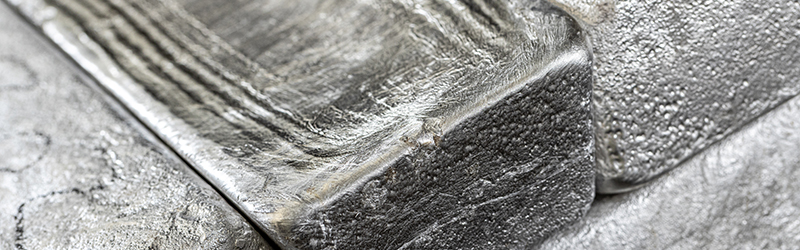
Elektron® 21 sand casting ingot

Our flagship high-strength, heat-treatable magnesium based casting alloy.

Product information

For use at temperatures up to 200˚C, this alloy has excellent corrosion resistance characteristics and castability, making it the suitable material for a range of aerospace applications.

Luxfer MEL Technologies has developed this lightweight, high performance alloy for aerospace applications. It is designed to provide superior mechanical properties and improved corrosion resistance together with good castability.
  • AMS 4429
  • UNS M12310
  • MMPDS
  • ASTM B80
  • ISO 16220 MC65410
  • Zinc: 0.2–0.5%
  • Neodymium: 2.6–3.1%
  • Gadolinium: 1.0–1.7%
  • Zirconium: Saturated
  • Magnesium: Balance

Castings are given the following T6 heat treatment to obtain optimum mechanical properties.

Solution treat for 8 hours at 520˚C (970˚F), Hot water quench using water at 60–80˚C (140–175˚F) or polymer quench, Age for 16 hours at 200˚C (400˚F), Air cool.

  • Specific gravity: 1.82
  • Coefficient of thermal expansion: 26.3 x 10⁻⁶K-1
  • Thermal conductivity: 116 Wm-1K-1
  • Specific heat: 1,086 Jkg-1K-1
  • Electrical resistivity: 94.6 nΩm
  • Modulus of elasticity: 44.8 x 10³ MPa
  • Poissons ratio: 0.27
  • Melting range: 545–640˚C
  • Brinell hardness: 65–75

Minimum specification tensile properties.

  • 0.2% proof stress: 145 MPa
  • Elongation: 2%

Castability

  • Excellent castability as a consequence of low oxidation characteristics.
  • Fine-grained microstructure.
  • Pressure tight

Pattern Makers Shrinkage Factor

1.5%

Weldability

Weldable by the tungsten arc inert gas process (TIG) with a filler rod of a similar composition. Castings should be heat treated after welding to obtain optimum properties.

Machining

Elektron 21 castings, like all magnesium alloy castings, machine faster than any other metal. Providing the geometry of the part allows, the limiting factor is the power and speed of the machine rather than the quality of the tool material. The power required per cubic centimetre of metal removed varies from 9 to 14 watts per minute depending on the operation.

Surface treatment

All the normal chromating, anodising and finishing treatments are applicable.

Corrosion resistance

ASTM B117 salt spray test corrosion rate for base metal:

  • <1.14 mg/cm2/day
  • <90 mpy

Typical tensile properties

  • 0.2% proof stress: 170 MPa
  • Tensile strength: 280 MPa
  • Elongation: 5%

Typical compressive properties

  • 0.2% proof stress: 168 MPa
  • Ultimate strength: 367 MPa

Typical shear properties

Ultimate stress: 172 MPa

Fracture toughness

KIC: 15.5 MPa m1/2

Fatigue properties

  • Pull-pull fatigue: R = 0.1
  • 5 x 10⁷ cycles
  • 115–120 MPa

Low temperature mechanical properties

Typical mechanical properties at -35˚C

  • Elongation: 7%
  • Ultimate tensile strength: 270 MPa
  • Impact value (notched): 1.7 J

Low temperature mechanical properties

Typical mechanical properties at -35˚C

  • Elongation: 7%
  • Ultimate tensile strength: 270 MPa
  • Impact value (notched): 1.7 J

Elevated temperature mechanical properties

Typical tensile properties
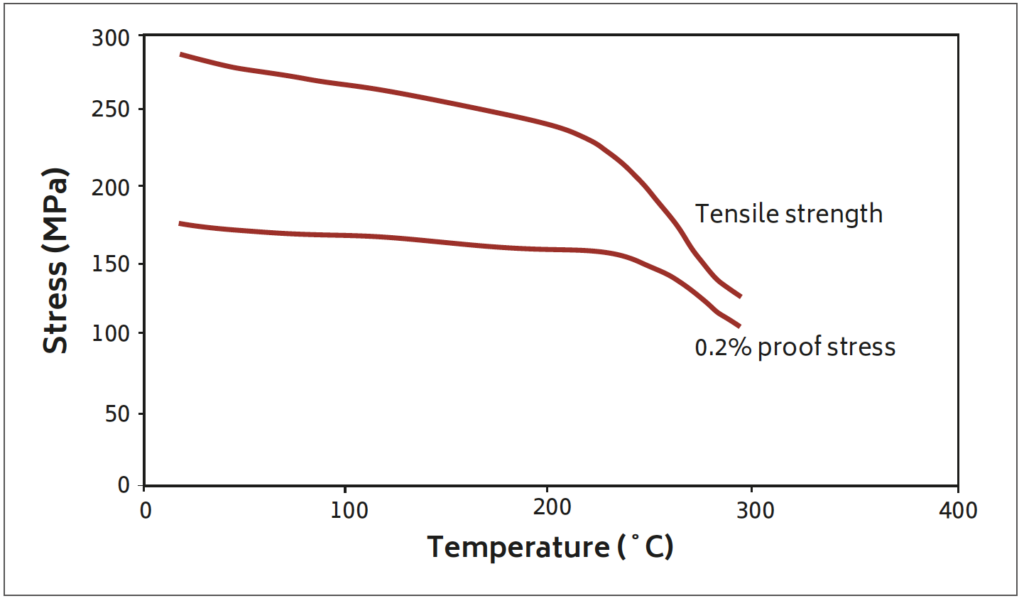
Figure 1. Effect of temperature on tensile properties.
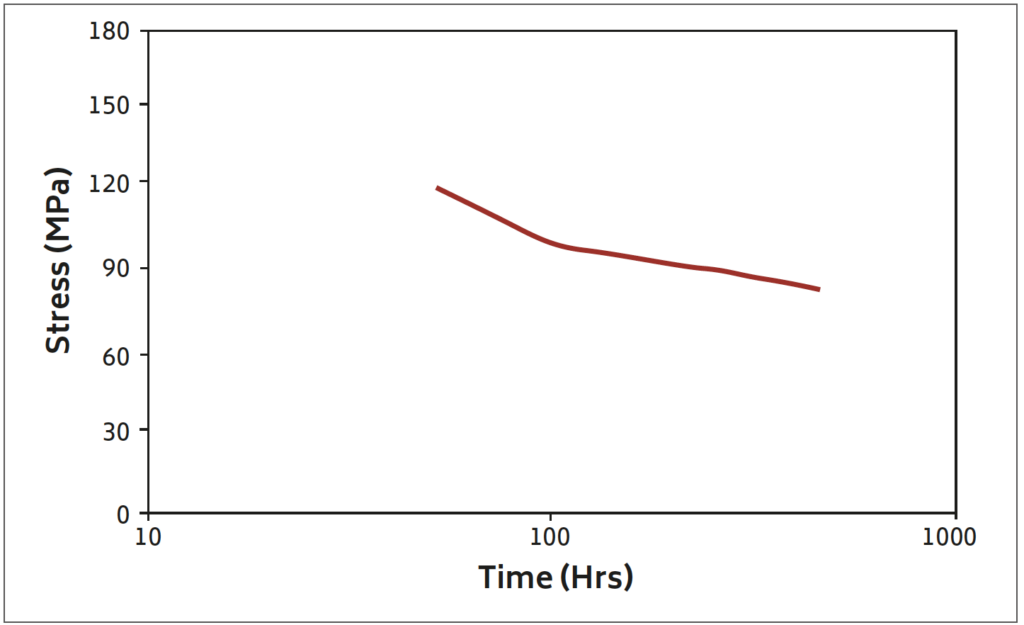
Figure 2. Stress /time relationship at 200˚C (0.1% creep strain).

Downloads and support

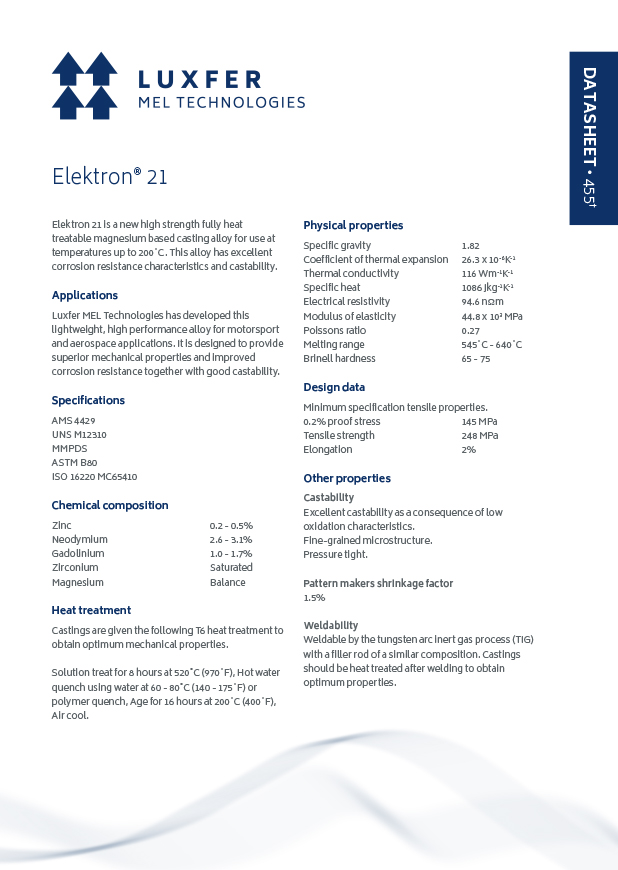
Elektron 21 datasheet

Need to speak to an expert? Message Daniel

Daniel Bacci

Regional Growth Leader, EMEA

Responsible for driving commercial growth across defence and elite motorsport markets. Daniel works closely with OEMs and prime contractors to develop mission-critical applications for advanced magnesium technologies, drawing on a background in financial markets in London, New York and Asia, as well as advanced industrial sectors.


    Need to speak to an expert? Message Thibaut

    Thibaut Caritey

    Technical Sales Engineer

    Thibaut leverages a deep engineering foundation and a decade of sales expertise at Luxfer to support the Aerospace and Defense industries. Specializing in Magnesium Castings across European and Asian markets, he ensures that design engineers can confidently select the right materials to meet the rigorous demands of next-generation technology.